
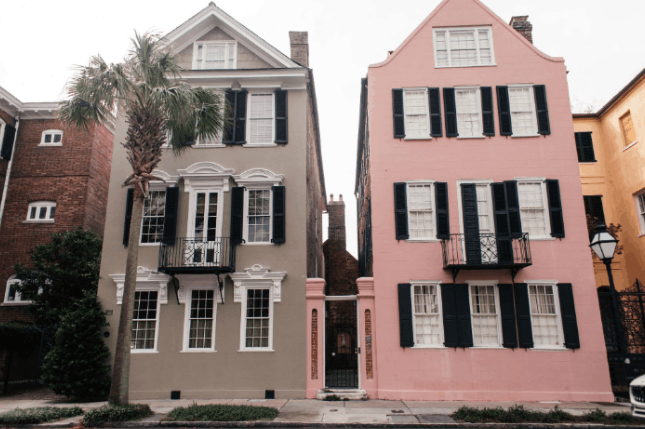
Rainbow Row is a group of 13 pastel-colored historic buildings on East Bay Street in downtown Charleston, South Carolina.
Rainbow Row at a Glance
| Visitor detail | Answer |
|---|---|
| Location | East Bay Street, between Tradd and Elliott streets |
| Buildings | 13 historic buildings |
| Admission | Free to view from the public street |
| Parking | No public parking on the block; use a nearby garage |
| Inside access | No, private residences |
| Best photo time | Morning |
| Architecture | Georgian row houses |
| Original use | Merchant shops and residences |
What Is Rainbow Row?
Rainbow Row is a group of 13 historic Georgian row houses on East Bay Street in Charleston, painted in pastel shades of pink, blue, green, and yellow.
It is one of Charleston's most recognizable and photographed sights, and it is known as the longest cluster of intact Georgian row houses in the United States. The houses stand in a continuous historic streetscape, creating the colorful sequence that gives Rainbow Row its name.
Where Is Rainbow Row in Charleston?
Rainbow Row is the name commonly given to the colorful historic buildings on East Bay Street between Tradd and Elliott streets. The historic marker identifies the 13-building row as 83 to 107 East Bay Street.
It sits on East Bay Street in downtown Charleston, near the waterfront, and is easy to combine with Waterfront Park and The Battery at White Point Garden.
Why Are the Houses Painted Different Colors?
The pastel colors began appearing in the 1930s, starting with Dorothy Porcher Legge's restoration of 99 to 101 East Bay Street in 1931.
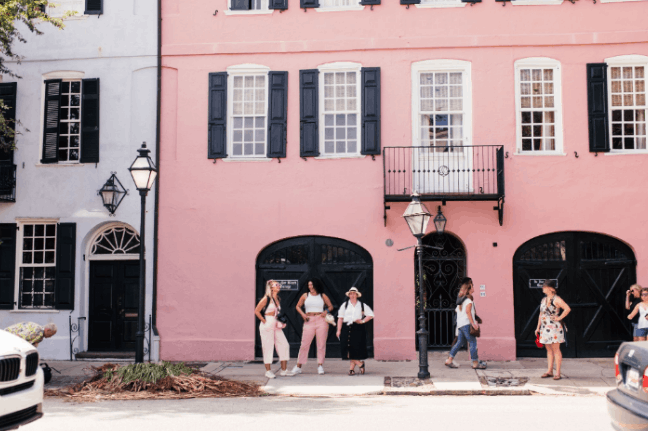
Legge's color choice was inspired by the bright pastel colors associated with colonial Caribbean architecture. Neighboring owners followed with their own soft shades, and as more of the buildings were restored and painted during the 1930s, 1940s, and 1950s, the block became known as Rainbow Row.
Q: Did the colors help drunken sailors find their way home?
A: No. That is a popular local legend, along with the idea that colors
marked what each shop sold. These stories are popular local legends, but they
are not supported by the historical record. The colors trace back to the 1931
restoration and the neighbors who followed.
The History of Rainbow Row
The buildings date to the 18th century and originally served as commercial and residential spaces for Charleston merchants.
When these buildings were first constructed, East Bay Street was directly connected to Charleston's working waterfront and wharves. Merchants used the ground floors as shops or counting rooms and the upper floors as living quarters, keeping their businesses close to the docks. As Charleston's waterfront commerce changed and the Civil War damaged the city's economy, the buildings declined and eventually fell into serious disrepair.
In 1931, Judge Lionel Legge and his wife, Dorothy Porcher Legge, bought a section at 99 to 101 East Bay Street and restored it, painting it pastel pink. That same year, Charleston adopted a groundbreaking historic-district zoning ordinance, widely recognized as the first of its kind in the United States.
Why Is Rainbow Row Famous?
Rainbow Row is famous for its 13 pastel-colored historic buildings, its 18th-century merchant history, and its distinction as the longest cluster of intact Georgian row houses in the United States.
The combination of bright color, preserved architecture, and a waterfront location has made it one of the most photographed spots in Charleston and a symbol of the city's historic-preservation story.
Who Lives in the Rainbow Row Houses?
The houses are private residences. People live there today, so the homes are not open to the public inside.
You are welcome to admire and photograph the houses from the public sidewalk, but please do not sit on the steps, enter the gardens, or knock on doors.
How to Visit Rainbow Row
There is no admission fee to view Rainbow Row from the public street, and it makes an easy stop on a walk through downtown Charleston.
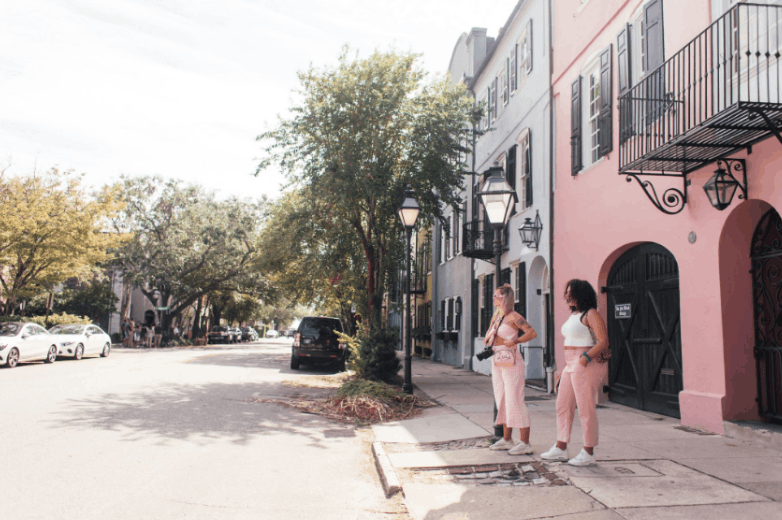
Plan on about 15 minutes for a quick photo stop, or longer if you are exploring the surrounding downtown area. It also fits naturally into a carriage or walking tour of the peninsula.
These are people's homes, so be respectful, keep to the public sidewalk, and pair your visit with nearby Waterfront Park and The Battery for a fuller morning downtown.
How to Get There and Park
There is no public parking on the block of East Bay Street where Rainbow Row sits, so most visitors park in a nearby garage and walk over.
The closest public garage is the East Bay/Prioleau Parking Garage at 25 Prioleau Street, a couple of blocks north on East Bay Street. From there, Rainbow Row is a short, flat walk south. In your map app, search for "Rainbow Row, East Bay Street, Charleston" for directions. If you are already exploring downtown on foot or on a tour, you can reach it without a car at all.
What Is the Best Time to Photograph Rainbow Row?
Early morning is the best time to photograph Rainbow Row, when the east-facing facades catch softer light and the sidewalks are quieter.
Going early also means fewer people and cars in your shots, before the tour crowds arrive later in the day. For the classic photo, stand on the sidewalk across the street and shoot along the row so several colored facades line up in one frame.
Where to Stay for a Charleston Visit
For travelers who want an apartment-style stay on the Charleston peninsula, The Iris Charleston at 84 Line Street offers suites with full kitchens and a convenient base for exploring downtown.
It is a boutique apartment hotel with more room than a standard hotel and a kitchen for longer stays. See the Charleston apartment-style suites or the The Iris Charleston hotel guide for the full picture.
Rainbow Row FAQs
Rainbow Row is generally described as a group of 13 historic buildings on East Bay Street between Tradd and Elliott streets.
On East Bay Street in downtown Charleston, between Tradd and Elliott streets, near the waterfront. The historic marker identifies the 13-building row as 83 to 107 East Bay Street.
Rainbow Row is on East Bay Street in downtown Charleston, between Tradd Street and Elliott Street.
For its 13 pastel-colored historic buildings, its 18th-century merchant history, and its distinction as the longest cluster of intact Georgian row houses in the United States.
The houses are private residences and are not open for interior tours. Visitors can see and photograph the buildings from the public sidewalk.
No. The houses are private residences and are not open to the public inside.
Yes. There is no admission fee to view Rainbow Row from the public street.
There is no public parking on the block itself. The closest public garage is the East Bay/Prioleau Parking Garage at 25 Prioleau Street, a couple of blocks north, and Rainbow Row is a short walk from there.
Early morning, for softer light and quieter sidewalks before the tour crowds arrive.
Plan on about 15 minutes for a quick photo stop, or longer if you are exploring the surrounding downtown area.