
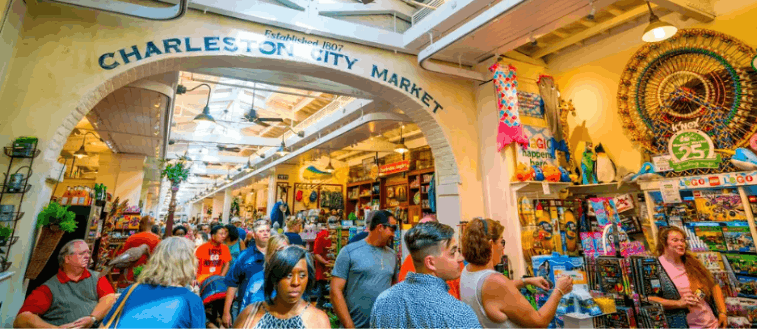
The Historic Charleston City Market is one of the oldest public markets in the United States, running along Market Street in downtown Charleston from Meeting Street to East Bay Street. It is free to visit, home to hundreds of local vendors, and famous for handwoven sweetgrass baskets. The day market is generally open daily, and a seasonal Night Market runs on Friday and Saturday evenings.
Charleston City Market at a Glance
| Location | Market Street, from Meeting Street to East Bay Street (Market Hall at 188 Meeting Street) |
| Day market | Opens 9:30 AM daily; closing time varies, so check the official site |
| Admission | Free |
| Night Market | Friday and Saturday evenings, about 6:30 to 10:30 PM, March through December |
| Parking | Metered street spaces, a surface lot at Church and North Market Street, and nearby garages |
What Is the Charleston City Market?
The Charleston City Market is a historic public market in downtown Charleston, made up of a series of open-air buildings, or sheds, filled with local vendors.
It runs along Market Street from Meeting Street toward the waterfront at East Bay Street, and it is one of the oldest public markets in the United States. Hundreds of vendors sell crafts, art, food, jewelry, and souvenirs, and the market is best known for Gullah artisans who weave sweetgrass baskets, a Charleston tradition passed down through generations.
What Time Does the Charleston City Market Open?
The Charleston City Market day market opens at 9:30 AM and generally runs through the afternoon. Current official pages list slightly different closing times, so check the Charleston City Market website before visiting.
The day market is generally open daily, except Christmas Day. The separate seasonal Night Market takes place on Friday and Saturday evenings and typically runs from about 6:30 to 10:30 PM.
The Charleston City Night Market
The Night Market runs on Friday and Saturday evenings, roughly 6:30 to 10:30 PM, from March through December.
It features around 100 local artists and makers, plus live entertainment, and it is free to walk through. The Night Market is a good option if you want a slower, cooler evening stroll, and it is known as one of the larger art markets in the region.
What Can You Buy and See?
Expect local crafts, art, jewelry, food, and souvenirs, with sweetgrass baskets as the market's signature item.
Take your time with the sweetgrass basket weavers, whose work is a longstanding Gullah cultural tradition. At the head of the market, Market Hall at 188 Meeting Street is a Greek Revival building completed in 1841. Its upper floor houses the United Daughters of the Confederacy Museum, while the market and shops occupy the spaces below.
Was the Charleston City Market a Slave Market?
No. The City Market was not a slave-auction site. This is a common and understandable misconception.
Enslaved people were present in Charleston's markets and were involved in bringing and selling agricultural products and other goods. But the City Market was not a place where enslaved people were bought and sold. Slave sales took place at other locations in Charleston, including the area around the Old Exchange and the site now known as the Old Slave Mart. This is a sensitive part of Charleston's history, and it is worth knowing the accurate story rather than the myth.
A Short History of the City Market
The land was set aside for a public market in 1788, and the market buildings were built in the early 1800s.
In 1788, Charles Cotesworth Pinckney gave the land to the City of Charleston on the condition that it always be used as a public market. The low sheds that stretch from Market Hall to the waterfront were built between about 1804 and the 1830s, and they originally held meat, vegetable, and fish vendors. Market Hall, the columned building at the Meeting Street end, was added later and still anchors the market today.
Getting There and Parking
There is parking around the Charleston City Market, including metered street spaces and a large surface lot at Church and North Market Street.
Nearby garages include the Church Street Garage, Hassel Street Garage, and Cumberland Street Garage. The market sits in the heart of downtown, so it is also easy to reach on foot from much of the peninsula, or as a stop on a walking or carriage tour.
Tip: weekends and holidays get busy. Go earlier in the day for a calmer visit, or come for the Friday or Saturday Night Market for a different feel.
Where to Stay Near the City Market
Staying downtown puts the City Market and the rest of the peninsula within easy reach.
The Iris Charleston is a boutique apartment hotel at 84 Line Street, one block off King Street and within walking distance of the market, with apartment-style suites and full kitchens. See the Charleston apartment-style suites or the The Iris Charleston hotel guide, and our Charleston restaurant guide for places to eat nearby.
Charleston City Market FAQs
The day market opens at 9:30 AM and generally runs through the afternoon. Current official pages list slightly different closing times, so check the official site.
The day market is generally open daily, except Christmas Day. The seasonal Night Market runs on Friday and Saturday evenings from March through December.
Yes. There is no admission fee to walk through and shop. You only pay for what you buy.
No. The City Market was not a slave-auction site. Slave sales took place elsewhere in Charleston, including the area around the Old Exchange and the site now known as the Old Slave Mart. Enslaved people were present in the markets and helped bring and sell goods.
There is parking around the market, including metered street spaces and a large surface lot at Church and North Market Street. Nearby garages include the Church Street, Hassel Street, and Cumberland Street garages.